Ceiling Water Damage Restoration in Argyle, TX
A wet ceiling is never just a ceiling problem. By the time a stain, soft spot, or sag shows up on an Argyle ceiling, water has usually moved through drywall, insulation, and framing above it for longer than the visible mark suggests. We provide ceiling water damage restoration for ceiling leaks tied to roof failures, burst pipes running above a room, bathroom overflows on the floor above, HVAC condensation, and moisture that has worked its way through drywall or plaster from somewhere else in the house.
Our first step is finding out how far the water actually traveled, not just treating the stain you can see. That means checking the space above the ceiling, the insulation resting on top of it, and the framing it is fastened to, before we talk about drying or repair. Skipping that step is how a ceiling gets patched and painted while the actual source keeps feeding moisture into the same cavity.
Signs Ceiling Water Damage Needs Immediate Help
Some ceiling damage can wait a day for a scheduled visit. Some cannot. A ceiling that is sagging, bulging, or heavy with trapped water is carrying weight it was never built to hold, and it can fail with little further warning. Active dripping, a light fixture or outlet that has gotten wet, and a stain that is visibly spreading while you watch are all signs the water above is still moving, not just left over from a past event.
If an Argyle ceiling is sagging or bulging, stay clear of the area entirely — a bulge can let go without much notice, and trapped water adds real weight fast. If water is coming near a light fixture or outlet, shut off power to that circuit if you can do it safely, and do not touch the switch again until it has been checked. None of this is a reason to wait; it is a reason to call and clear the room while help is on the way.
A firm, stained ceiling that is not growing and not dripping is a different situation — it still needs attention, but it is safe to walk under while you wait for a scheduled visit. Telling the two apart from the floor below is mostly about whether the ceiling is holding shape: flat and firm can wait a day; anything soft, bowed, or heavier-looking than it was yesterday cannot.
Common Causes of Wet Ceilings
Roof leaks are the obvious cause, but a large share of the ceiling calls we get across Denton County trace back to something inside the house rather than the roof. Attics in North Texas run hot for most of the year, and that heat difference is exactly what makes air conditioning ductwork sweat — the cool air inside the duct meets hot attic air outside it, condensation beads on the surface, and it drips onto the insulation and drywall below. From the room underneath, that looks exactly like a roof leak, but the roof has nothing to do with it.
A bathroom exhaust fan plumbed into the attic instead of vented outside through the roof or a soffit is the other repeat offender. Every shower sends its moisture into the space above the ceiling instead of out of the house, and it takes months of that pattern before enough saturation builds up to show as a stain. Plumbing running through a floor above — a bathroom, laundry room, or upstairs kitchen in an Argyle two-story — along with a tub or toilet overflow on the level above, are the other frequent sources. Single-story slab homes are not exempt either: in a one-story Argyle house, a wet ceiling almost always points to the attic, whether that is a roof leak, a duct that has sweated for months, or a bath fan that was never vented outside to begin with.
Drying, Removal, and Reconstruction Decisions
Once the source is controlled, the question becomes what can be dried in place and what has to come out. A small, recently wet area of painted drywall with sound framing behind it can sometimes be dried without removal. A ceiling that has been wet for days, has sagged, or has insulation saturated above it generally cannot be saved — waterlogged drywall loses its structural integrity, and wet insulation stops insulating and starts holding moisture against the framing instead.
Structural drying covers how we set air movers and dehumidifiers to a target and monitor the cavity until moisture readings, not appearance, say it is dry. Where drywall or insulation has to come out, we cut back to sound material, dry what remains, and document exactly what the ceiling will need to be closed back up — information the crew handling the rebuild needs, whether that is us or a contractor you choose separately.
Texture and paint are the last step for a reason. A ceiling can look fine on the surface and still be wet behind it, which is why we go by readings taken at the same points over several days rather than by how the drywall looks or feels. Closing a ceiling back up before it reaches a dry baseline is how a stain in an Argyle home reappears a month later, larger than it started.
Mold and Insulation Concerns Above the Ceiling
Wet insulation and wet drywall sitting inside a closed ceiling cavity are exactly the conditions mold needs, and a ceiling void is easy to miss because nobody is looking up there day to day. If an Argyle ceiling has been wet for more than a day or two, or there is a musty smell with no visible stain yet, that is worth treating as a moisture problem with a possible growth problem behind it, not just a stain to paint over.
We do not diagnose mold by looking at a dark spot, and we will not tell you a ceiling is mold free — nobody can promise that honestly, since spores exist in every indoor environment already. What we can do is dry the area properly and flag anything that looks like active growth so it gets handled correctly. Visible growth found once the ceiling is opened up is a job for mold remediation, not for painting over.
Documentation for Insurance and Repairs
From the first visit, we photograph the stain, the source area, and the cavity once it is opened, and we record moisture readings from the affected drywall, insulation, and framing. That record is what most Argyle customers bring to their insurer, and it is also what a repair crew needs to know what was removed and why.
To be direct about what we do not control: whether your policy covers the loss, and what it pays toward it, is a decision your carrier makes, not us. We document the damage thoroughly and answer the adjuster's questions; we do not promise an outcome on a claim. Once drying is complete and the scope is documented, rebuilding the ceiling — new drywall, texture, paint, insulation — is repair work our remodeling team can coordinate, so the same job does not require a separate contractor search.
Also Serving Areas Near Argyle
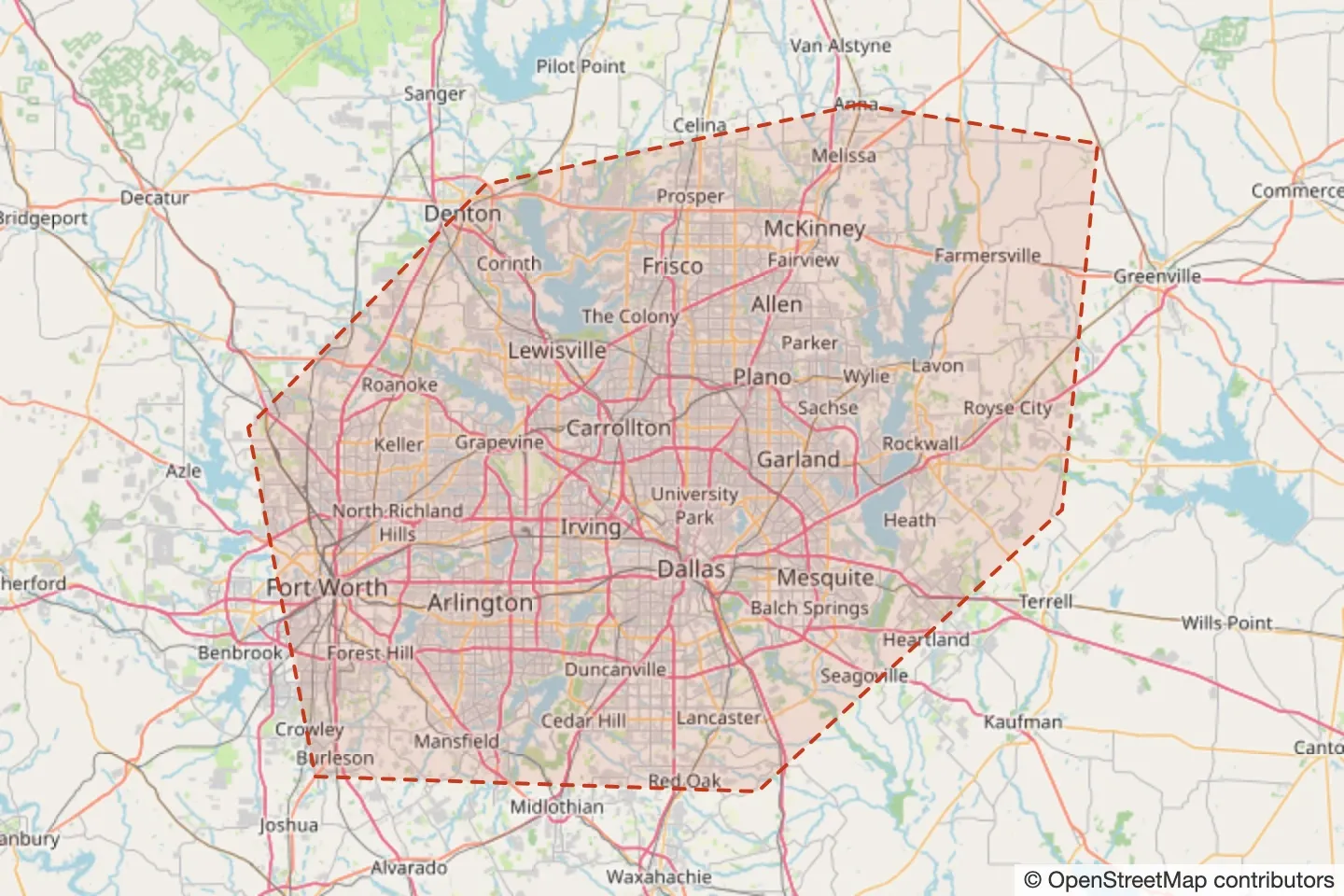
Our Argyle crews also cover Denton, Flower Mound, Trophy Club, Aubrey. If your property sits between two of these, call and we will tell you straight whether we can reach you.
Get Ceiling Water Damage in Argyle, TX
If an Argyle ceiling is stained, sagging, dripping, or smells musty, do not wait to see whether it dries out on its own — a ceiling cavity rarely does. We will find out where the water came from, tell you plainly what can be dried and what has to be removed, and document everything along the way. The on-site estimate is free, and we also cover Denton, Flower Mound, Trophy Club.